Shirts, Street Smarts, and a World Cup Miracle: Argentina’s Blue Jersey that Shaped 1986
4 December 2025
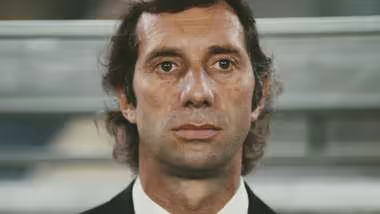
In the heat of Mexico City’s Azteca Stadium and under the looming memory of recent wars, Argentina’s 1986 World Cup journey blended meticulous planning with street‑level improvisation. Coach Carlos Bilardo insisted on a tight 3-5-2 structure, a plan devoted to discipline and defense, while Diego Maradona carried the weight of a nation hungry for glory. Public doubt was loud, but the team pressed on, driven by a mix of tactical rigor and the fearless creativity that defined Argentine football.
Behind the headlines of Hand of God and the Goal of the Century there lived a quieter, stranger chapter: a makeshift kit crisis that could have derailed everything. Before the quarterfinal with England, FIFA required darker shirts to distinguish Argentina from their white‑kit opponents. The problem was practical and dangerous in the high noon heat: the only spare kit available was a thick cotton substitute, far too heavy for the Azteca sun. The risk wasn’t merely cosmetic; heavy fabric could injure players in a game of such intensity.
World Cup Under Pressure
In Buenos Aires, skepticism grew that Bilardo’s defense‑first approach could translate into World Cup success. The jury was out on whether this meticulous, sometimes clinical method could coexist with Maradona’s flamboyant genius. Yet as the tournament began, the Argentine camp clung to a belief: every detail mattered, from hydration charts to the rhythm of training sessions, and from the substitutes’ warm‑ups to the exact cut of the jerseys that would glow under stadium lights.
As pre‑tournament nerves sharpened the mood at home, the squad’s unity and the nation’s democratic turmoil created a backdrop where football mattered as a national mood‑piece. The point wasn’t merely to survive the group stages but to prove that a team could blend stubborn organization with spontaneous brilliance at the moment of truth.
The Shirt Crisis
That crisis began in a surprisingly ordinary place: Tepito, a street‑wise district in Mexico City where markets spill into alleys and improvisation is a survival skill. The kit chief, Héctor Zelada, and the equipment team wandered into the maze of stalls, hoping to find a lightweight, breathable option—anything that could save the players from the blistering sun. What they found would become legend: a batch of blue, lightweight polyester shirts with silver numbers, produced under less glamorous circumstances but perfectly suitable for the weather and for the moment.
Maradona’s teammates joked that they had gone from a stitching room in a hotel to the back lots of Tepito’s shops, where seamstresses and tailors worked with a sense of urgency that felt almost cinematic. The shirts, though technically counterfeit in origin, were transformed into something genuine: a real Argentinian kit for a night of high drama. When the players emerged in these blue tops, the image matched the mood on the field—swift, nimble, and determined to prove that resourcefulness can trump rarity.
According to Zelada and Jorge Valdano, the transformation was less about fashion and more about function. Some shirts came out imperfect, others dazzling; what mattered was that the team could play without the fear of overheating, without surrendering pace or precision. The makeshift solution quickly became a symbol: a collective effort to turn a potential disaster into a moment of national pride.
From that serendipitous street gamble emerged a new archetype of football ingenuity—a reminder that heroes aren’t always forged in pristine factories or polished Olympic halls, but sometimes in crowded markets, under time pressure, wearing borrowed blue threads that became brighter with every pass and run.
The Final Flourish
With lighter, cooler kits and a revived sense of purpose, Argentina advanced to the arc of the tournament. Maradona’s genius shone again, producing the Hand of God and the Goal of the Century in the same match against England, followed by Burruchaga’s late finish that sealed a 2‑1 victory. The jersey’s journey from Tepito to the Azteca was more than a wardrobe fix; it was a metaphor for a team that refused to be flattened by heat, doubt, or shortage.
As the World Cup unfolded, the blue shirt ceased to be a mere piece of clothing and evolved into a cultural emblem—an emblem of improvisation, unity, and the stubborn belief that magic can be stitched together from the most unlikely places. The legacy of that jersey endures: a reminder that greatness sometimes wears a price tag of two pesos and a dash of thread leader’s courage.
And if you’re wondering about the moral of the story: when life hands you a heatwave and a faulty kit, you don’t just survive—you tailor a legend. As one old market vendor might have told you if he spoke in English instead of street‑wise Spanish: If you can’t buy luck, borrow a shirt, and make history with a stitch of wit. And yes, maybe that’s the real Hand of God—the one that secrets a seam into destiny.
Punchline time: 1) If a market shirt can outplay a defense, maybe your laundry day could use a tactical upgrade. 2) In football as in life, sometimes the best gear is the stuff you thrift in a busy street—cheap, brave, and somehow perfectly suited for a title run.