
Torres Takes a Timeout: Spain’s Attack Face a Hurdle Before Bulgaria Showdown
13 October 2025
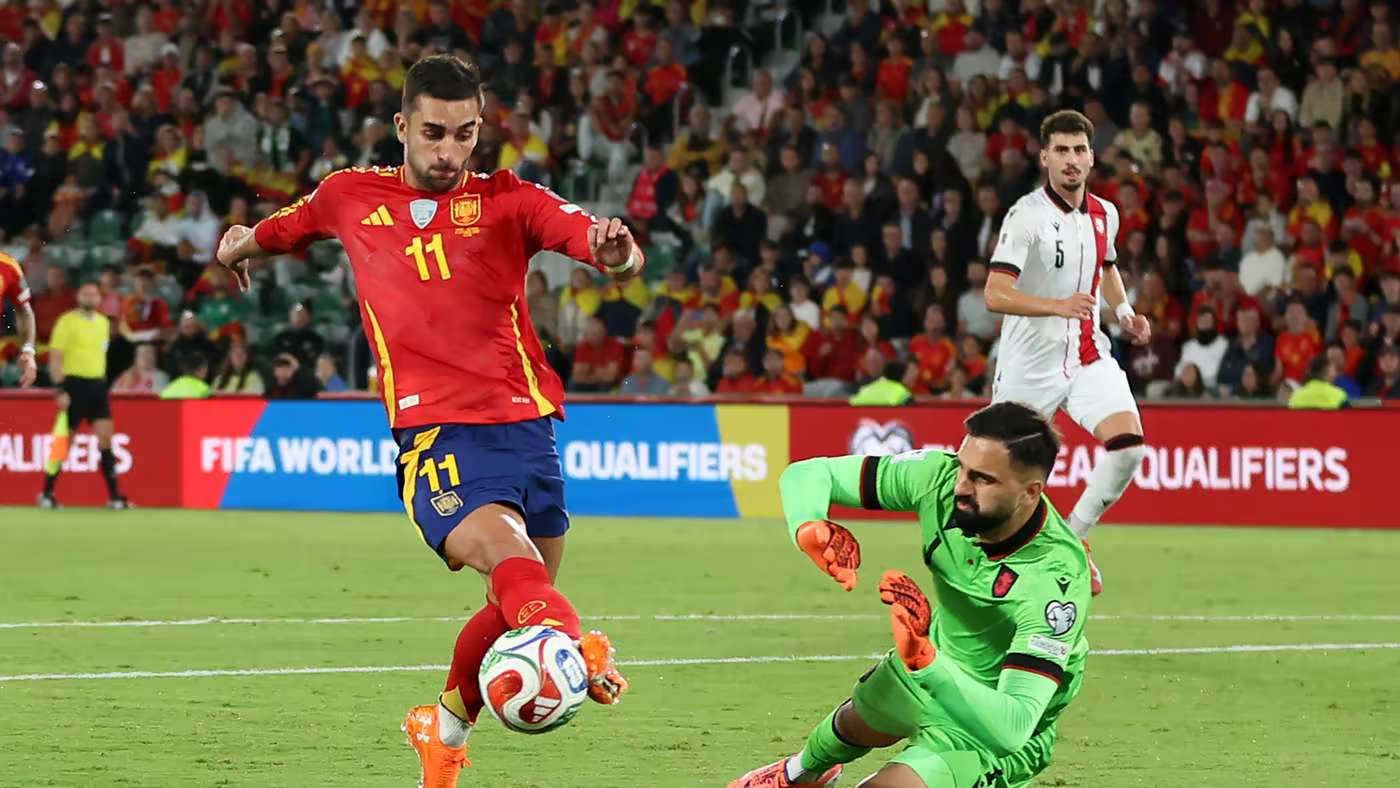
Ferran Torres Withdrawn from Spain Camp Ahead of Bulgaria Clash
The Spanish Football Federation announced on Monday that Barcelona forward Ferran Torres has been ruled out of the Spain squad ahead of Tuesday’s World Cup 2026 qualifier against Bulgaria in Valladolid, due to muscle fatigue, described as a strain rather than a tear.
According to Mundo Deportivo, Torres will return to Barcelona this evening for examinations under the club’s medical staff, who were fully briefed by Spain’s doctors.
Torres had played last Saturday for Spain against Georgia in Elche, and afterward reported muscular pains. Medical tests confirmed a muscular strain but found no structural injury.
In a statement, the federation said the player “complained of muscular pains” and that “additional tests showed fatigue without a physical injury.” Given the close proximity of the Bulgaria match and a policy of not risking the player, he was left out of the squad.
This decision follows a period of tension between Barcelona and the federation over injuries from the international window, including Lamine Yamal’s issue, which reportedly displeased Barca coach Xavi and influenced squad decisions upon return.
The federation’s release stressed that Barcelona’s medical staff were informed of Torres’s condition and that the club’s doctors had access to all medical details from the national team doctors.
Torres himself reportedly told the coaching staff about the fatigue after the Georgia game, and an agreement was reached for his return to the club without taking risks with his participation against Bulgaria.
Meanwhile, Spain coach Luis de la Fuente does not plan to call a replacement for Torres, especially after Barcelona’s other winger Dani Olmo left the squad early due to a left thigh muscle injury, which will sideline him for several weeks.
In the shadow of Lewandowski: Torres’s breakout under Flick
Over time, Ferran Torres has emerged as one of the standout beneficiaries of Hans Flick’s era at Barcelona. He has evolved from a winger with limited minutes to a true central striker, confident in his goal threat.
Although doubts linger about his fit as a pure number nine under Xavi Hernandez, Flick’s system and trust in him gave Torres the central role he sought at the top of the attack.
After a big win over Valencia last September, Flick said, “It’s great to have a choice between Ferran and Lewandowski. I’m happy to have players of this quality in this position.”
By October, Torres had started eight games and been a substitute in only two, establishing himself as a genuine attacking weapon under the new coach.
Torres’s path to a central striker role did not begin at Barcelona; it started at Valencia under Marcelino, who gave him his first meaningful chances, before Alberto Celades tried him as a true center-forward.
Celades recalled, “We moved him there several times despite him never having played that role; injuries forced us to rely on him, and his technical ability and movement made him adaptable.”
He was strong in the air and had a natural goal sense, qualities that later blossomed at Manchester City under Pep Guardiola after Sergio Aguero’s long absence due to injury.
A City staff member at the time explained, “Ferran came in because Aguero was hurt most of the season; we needed a striker. He has a strong goal instinct, moves in the final third, and can be a reference in attack.”
We then worked with him intensively to master the movements required of a forward; although center-forward was not his original role, we saw potential for him to adapt and thrive.
When he arrived at Barcelona, Xavi described him as “a world-class player who understands spaces well and doesn’t lose possession.”
Yet the competition up front—Aubameyang, Luuk de Jong, Memphis Depay, and Lewandowski—meant Torres did not enjoy consistent central minutes at first.
As one staff member noted, “We didn’t grant him the continuity he needed, but he contributed a lot in high-pressing and recovered balls thanks to his relentless work rate.”
Another explained, “In attack, he moves smartly in the spaces, but we needed a player who could deliver the final pass, and that frustration pushed Xavi to use him on the wing where his shooting is a strength.”
This season, with Lewandowski’s form and age affecting his role, Torres has emerged as Barcelona’s present and future number nine. The player forged by Guardiola and trusted by Xavi has found under Flick the right environment to prove he is more than a winger—a true striker capable of leading the line with steadiness and confidence.
Whether this season marks the final stage of his evolution remains to be seen, but the trajectory is clear: Torres is no longer a hopeful winger; he’s a weapon for Barcelona’s attack.
Punchline time: 1) If Torres keeps scoring, Barcelona might rename the position to “Torres-ter.” 2) With this much depth up front, the only thing fiercer than their press is the bench press that still hasn’t opened a seat in the first XI.