
Is Real Madrid Eyeing the Next Toni Kroos? Angelo Stiller Emerges Under Flick’s Lens
1 February 2026
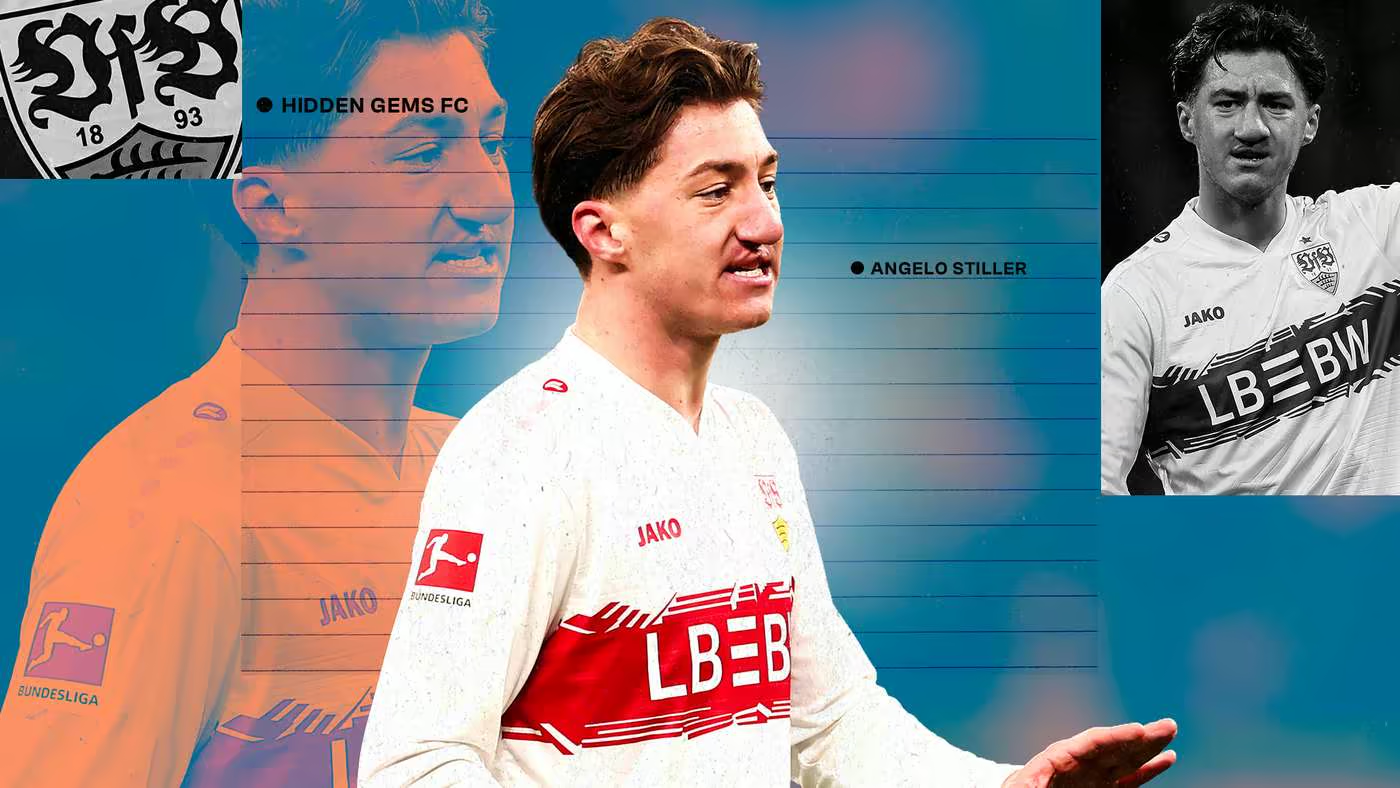
From Bayern’s Academy to Real Madrid’s Spotlight
Angelo Stiller, 24, made his professional debut under Hansi Flick, but his development has become closely tied to Sebastian Hoeness. Bayern’s state‑of‑the‑art academy, designed to curb the fever for expensive transfers, is yielding results with Jamal Musiala and Lennart Karl among its rising stars, and Stiller stands as the latest example of the system’s success.
Inside Bayern’s training complex, there is a clear rationale: a decade of frustration over too few academy graduates reaching the first team led to the creation of a high‑end facility. David Alaba was the standout homegrown player for many years, illustrating both the potential and the risk of relying on youth. Oli Hoeness, then club president, framed the new complex as a response to the market’s insanity and the need to build players from within.
Time has vindicated the approach. Musiala is the prime illustration of the academy’s payoff, while Lennart Karl is another promising graduate. Josip Stanišić and Aleksandar Pavlović have become regulars, reinforcing the message that Bayern’s developmental model can produce first‑team contributors and international players alike.
According to Hoeness, the club’s development chief, the aim was to avoid chasing inflated transfer fees. “Musiala is now valued at around €100 million, a first step in the right direction,” he said, underscoring the financial and sporting rationale behind the investment.
But the spotlight on Stiller isn’t only about what Bayern has produced; it’s also about what Stuttgart found attractive. Stiller trained at Bayern’s cutting‑edge facility as a youth, and his path later intersected with Hoeness again when the former Bayern coach moved to Hoffenheim and then brought Stiller with him to Stuttgart in April 2023, a reunion that illustrates the trust between player and mentor.
Stiller’s journey has fueled speculation about his ceiling. He has drawn comparisons with a certain German great and has been discussed as a potential heir to a certain Kroos in Madrid’s plans. In a conversation with Bild, Stiller acknowledged Toni Kroos as “the best German player of all time” and admitted that replacing such a figure would be a tall order, a sentiment that only heightens Madrid’s interest.
As a deep‑lying playmaker, Stiller is already known for his ability to orchestrate from midfield. His intelligence, distribution, and vision place him among Europe’s promising passers, and his evolution at Stuttgart will be watched closely by scouts from top clubs.
11 Years in Bayern’s Academy
Colloquially described as a long apprenticeship, Stiller’s eleven years in Bayern’s youth system shaped his understanding of the game. He has spoken about the desire not to repeat past mistakes by letting talent slip away and to maximize what the academy has to offer—an ethos the club has reiterated through comments from Hoeness and others.
That pathway proved fruitful for Musiala, whom Bayern nurtured into a world‑class asset, and it has given Stiller a template for how to progress. The environment emphasized technical and tactical rigor, and the stories of graduates who stayed within the club’s ecosystem reinforced the project’s value to players and fans alike.
The narrative around Stiller is inseparable from the broader arc of Bayern’s development strategy: a commitment to cultivating players who can influence the first team while maintaining the club’s financial sustainability. While Stiller’s next moves remain to be seen, his career thus far embodies the philosophy that Bayern hoped to solidify a decade ago.
In the broader European market, the attention on Stiller reflects a trend: clubs are eyeing the breadth and depth of German talent, especially those who can perform as playmakers and tempo setters in big leagues. Real Madrid’s interest, alongside chatter from Manchester United, signals that the current crop of homegrown players continues to attract suitors who believe in the value of a player who can control the tempo and contribute critical passes in tight spaces.
Ultimately, Stiller’s development will be judged by his ability to translate potential into sustained impact for Stuttgart and beyond. If he maintains the trajectory he has shown, the comparison to Kroos may become less of a stretch and more of a forecast—though no one is rushing to replace a legend, not even in football’s most forgiving locker room.
Punchline 1: If patience is a virtue, Stiller is auditioning for sainthood—one well‑placed pass at a time.
Punchline 2: Real Madrid’s scouting department must think they’ve discovered a time‑traveler who can relive Toni Kroos’ prime—without the travel costs.