
Numbers Don’t Lie: Salah’s Struggles Shadow Liverpool’s Season of Switches
11 October 2025
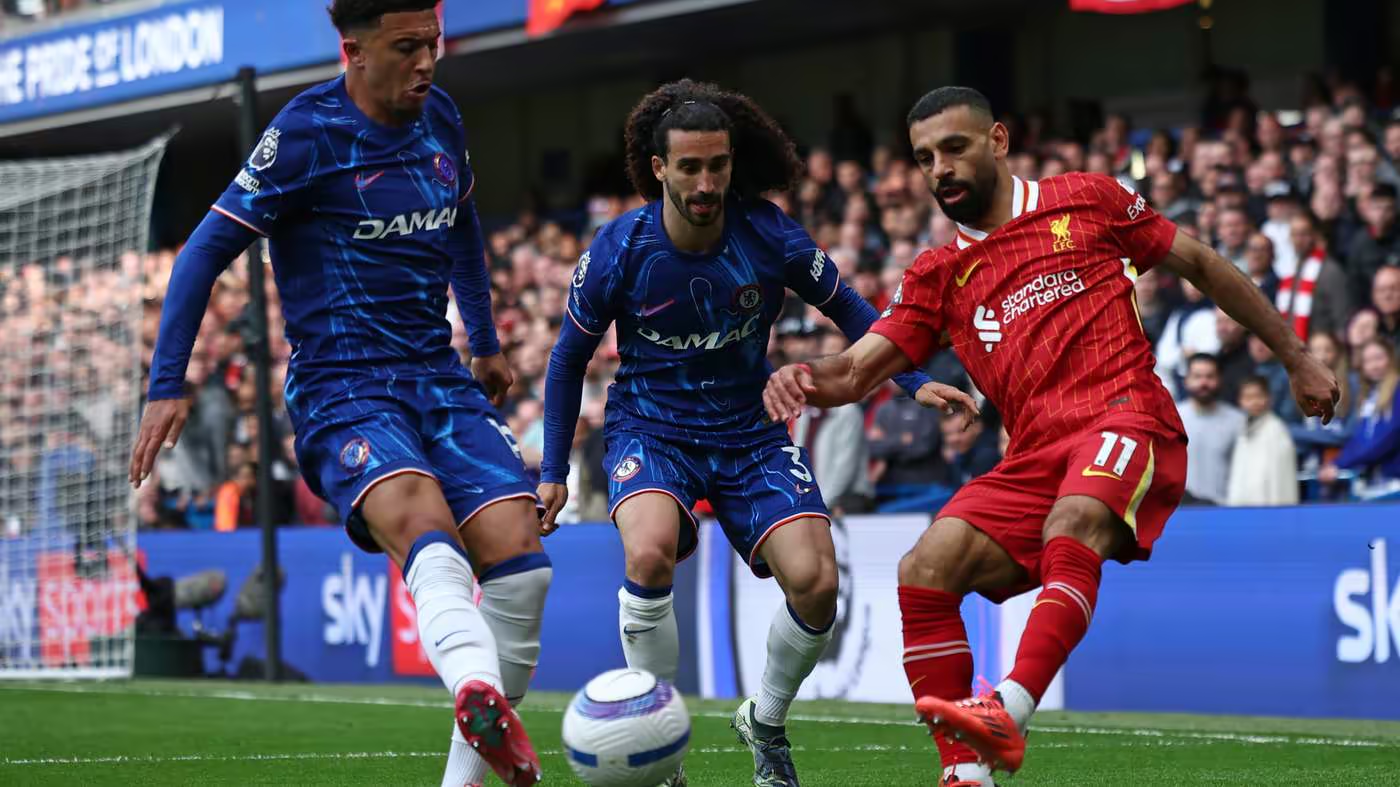
Liverpool’s Late Defeat and Salah’s Slump
It wasn’t the first time Liverpool fans left Stamford Bridge frustrated by a late Chelsea strike, but it carried extra sting because Mohamed Salah missed two clear chances that could have altered the result and perhaps his season.
What unfolded this season is a troubling pattern for Salah: inconsistent form, a streak of bad luck, and a team that seems to have lost some of the aggressive attacking identity that once unsettled opponents a year ago.
Early in the campaign, Reds supporters savored late winners, but the mood shifted in the last two weeks as the balance swung away from drama toward doubt.
Liverpool have been beaten in two London games by Crystal Palace and Chelsea, both 2-1 with a late goal decided the day.
Salah no longer appears as the savior, and he found himself unable to break the cycle of misfortune. Against Chelsea, two clear chances went begging as he left the home ground of his former club defeated.
A season-wide dip
Last season Salah was one of the world’s finest, finishing with 57 goal contributions (34 goals, 23 assists), a mark unmatched by others in Europe’s top five leagues, yet finishing fourth in the 2025 Ballon d’Or as misjudgments and circumstances weighed on his tally.
The start of the 2025-26 campaign looked solid by some metrics: two decisive late goals in the opening five league games, including a penalty vs Burnley, and a sublime goal against Atletico Madrid in the Champions League. Still, that spark proved fleeting amid a broader downturn in Liverpool’s performance.
Liverpool opened the season with seven official wins but played with muted intensity, including a League Cup victory over Southampton. The questions quickly followed: would the performance lift with time, or would the results mask a deeper issue of structure?
A notable decline
Opta numbers tell part of the story: Salah’s touches per game fell from 48.6 last season to 42.6 this season—the lowest rate since he joined Liverpool in 2017.
In the box, his touches dropped from 9.6 per 90 to 5.5, another low for his Liverpool tenure. His dribbles per game dropped to 1.6 with a success rate under 20%, compared to 3.5 attempts at 39.3% last season.
In the Premier League specifically, Salah completed only one successful dribble from 11 attempts—a sign more of a confidence issue than a pure physical decline.
Even his shot rate ticked down: 3.4 attempts per game dropped to around 2.0, while expected goals (xG) slid from 0.63 to 0.32. In raw terms, he has four goals from 52 non-penalty shots in the last 24 matches—a rough figure for a player of his caliber.
Where is the fault?
Blaming Salah alone would be simplistic; the numbers point to a broader issue with Liverpool’s new configuration.
With Trent Alexander-Arnold’s departure, Salah lost a key conduit of through-balls and incisive passes. Last season, Alexander-Arnold delivered 147 passes that sliced through the lines—more than any other pair in the league—of which 37 were through-balls that breached defenses. This season, Alexander-Arnold’s absence left a gap that Salah hasn’t been able to fill on his own.
When Trenta’s partner was present, Salah scored 27 goals and averaged 3.5 shots per game with 0.48 expected goals per non-penalty. In the 12 games without him, Salah has four goals (two from penalties) and his per-game shooting count fell to 2.3, with 0.3 expected goals.
Trying (and not fully succeeding) to diversify
Manager Arne Slot experimented with options to offset the missing link. Dominik Szoboszlai often operated as a right-sided provider, delivering 23 through-balls this season, but the quality and understanding with Salah weren’t replicated. Floriane Wirtz managed seven through-balls in seven games; Conor Bradley contributed eight inconsequential passes, while Jerémie Frimbong has yet to register a meaningful through-ball for Salah.
Liverpool as a team still tops the league in progressive passes (roughly 444 total), but the distribution has widened—Salah is no longer the primary target of these moves.
Slot’s goal to diversify attack has, in effect, diluted Salah’s most lethal threat factor.
A decline in creativity, not in spirit
Creativity remains a part of Salah’s game; he still creates chances regularly, but the rate has softened. He’s producing about 1.6 chances per game, down from 2.1, while the expected assists (xA) remain near-parity at around 0.23, and big chances created have hardly changed overall.
Notable creative moments this season include a through-ball to Ryan Gravenberch against Everton and a curved cross to Alexander Isak against Chelsea—moments that could have become goals with sharper execution.
Where Salah receives the ball now
Rather than clustering inside the penalty area, Salah now often receives near the right touchline in the opponent’s half (about 13 touches per game in that zone, his highest ever in that area). In plain terms, he’s steadier and less varied, making him easier to read for defenders and less dangerous in the final third.
Additionally, progressive passes to Salah have fallen sharply—from 297 last season to just 41 this season that he has received, placing him sixth in this metric and underscoring a shift away from him as the primary conduit for buildup.
Slot’s attempt to diversify the attack has reduced Salah’s influence on the scoreboard.
A small bright note on a dim season
Creativity hasn’t vanished entirely; Salah still delivers chances regularly, and a spark remains. The issue is more structural than personal—a team-wide adjustment that has temporarily muted Salah’s peak productivity.
Five of Liverpool’s seven early opponents currently sit in the top eight, including Newcastle, Chelsea, and Crystal Palace, with only one match against a lower-table side (Burnley) so far. Naturally, the tougher schedule compounds Salah’s frustrations, and the challenge now is restoring confidence ahead of an easier run of fixtures to come.
On the human side, Salah endured a painful personal moment in July with the death of close friend and teammate Diogo Jota. His tears after the season-opening win over Bournemouth were a poignant reminder of the emotional weight he carried into form issues, and fans sang Jota’s name in tribute—a moment that underscored the personal impact behind the numbers.