
Germany's No. 9 Quest: Chasing a Modern Muller-Klose Heir
29 December 2025
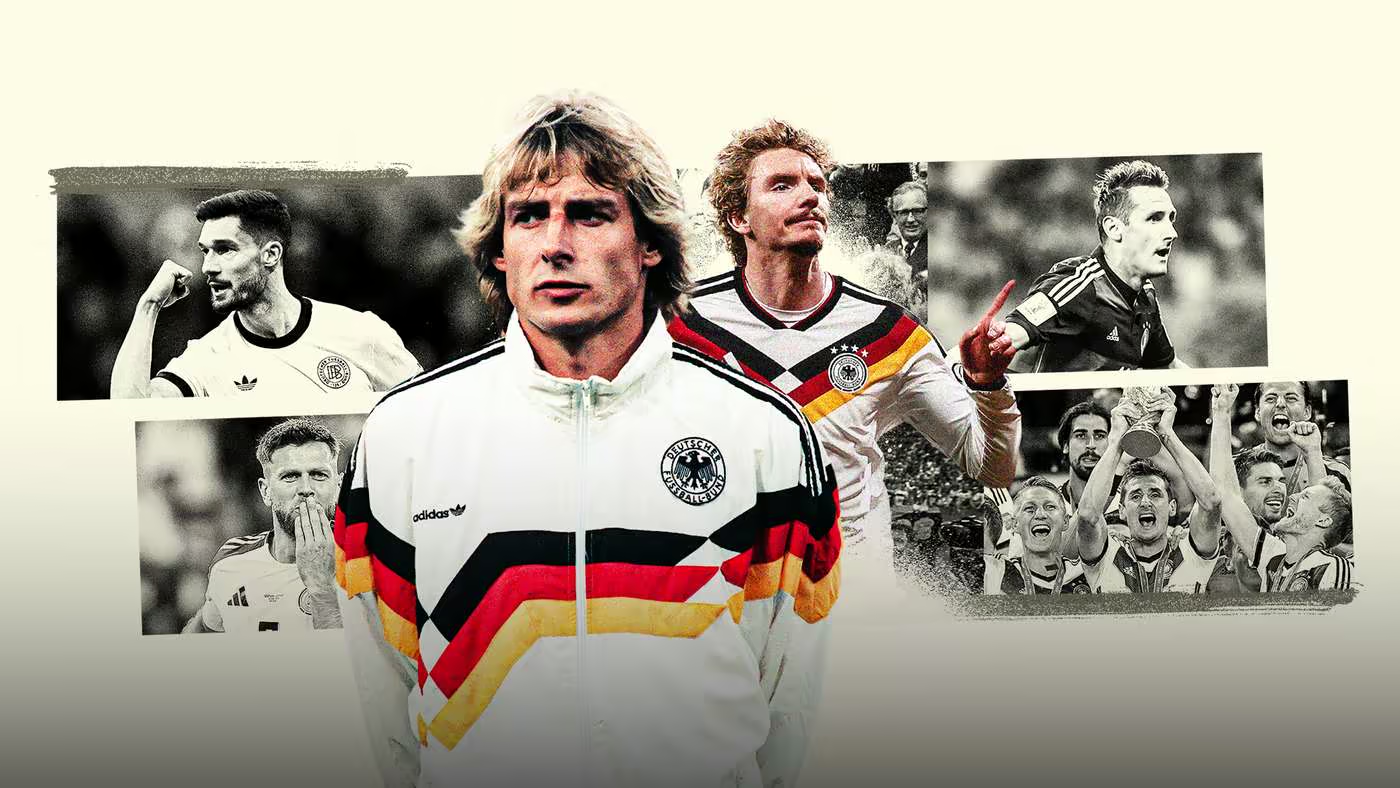
From Gerd Müller to Miroslav Klose, the No. 9 shirt stood for power, precision, and national pride. Yet since 2014, that legacy has morphed into an ongoing question as Germany searches for its next marquee striker—and perhaps a fresh sense of identity along with it.
Historically, Germany’s greatest team feats also exposed a substantive problem: the absence of a sustained, world-class center-forward. When Klose netted his 16th World Cup goal in the unforgettable 7-1 win over Brazil in Belo Horizonte in 2014, he didn’t merely cap a stellar career; he symbolically closed a chapter—the era of the classic German striker. For more than 13 years and 137 caps, Klose embodied clinical finishing, a standard that the post-2014 generations have found difficult to match.
That era’s end coincided with a shift in how Germany trained forwards. Rather than relying on a lone No. 9, coaches poured energy into nurturing versatile forwards who could participate in build-up, exploit spaces, and press as a collective. Players like Mario Gotze, Thomas Müller, and Kai Havertz carried the idea of a multifaceted attack, but the true, unwavering finishing instinct that defined Müller and Klose proved hard to replace in the national setup.
The search for a replacement intensified as Germany endured a run of tournaments where the fixed striker role was tested by experimental systems—false nines, rotated forwards, and hybrid profiles. By the time the World Cup 2022 and the Euro 2020 cycle rolled around, it became clear that philosophy alone couldn’t conjure a reliable finisher in the box when it mattered most. The broader question emerged: where did the German striker DNA go, and can it be rekindled?
In recent years, German football’s response has been to rethink development across age groups. The emphasis shifted toward creating forwards who can combine technical polish with physical presence, capable of attacking spaces and finishing under pressure. The idea was not to eradicate the No. 9 archetype but to reframe it so young players could grow into it rather than be thrust into it prematurely. The reform has produced an array of multi-talented forwards, but the finishing touch in decisive moments remains a work in progress.
Reality soon pressed back: while the best clubs in Germany cultivate players who can read the game and contribute in different zones, the national team still searches for a blueprint that marries the old authority of the No. 9 with the demands of modern pressing and counter-pressing. The challenge has been to balance a robust physical presence with the cerebral, predictive finishing that once defined the great German forwards.
Now, as the 2026 World Cup approaches, attention has shifted to individuals who could bridge eras. Niclas Füllkrug has emerged as the most prominent contemporary candidate, a powerful striker whose frame and finishing instincts echo the classic No. 9 while his technical acumen fits today’s game. The authorities—Julian Nagelsmann and Rudi Völler—have signaled that he is part of a broader plan to reintroduce a true, vertically oriented striker into a system that can also sustain the midfield and wing play Germany already possesses.
The debate, however, extends beyond a single player. It encompasses a philosophy: train strikers to own the area in front of goal, emphasize finishing under pressure, and drill the situational awareness that defines great center-forwards. The aim is to cultivate a steady pipeline of forward talents who can adapt to the game’s evolving tempos while preserving that essential instinct to finish—a trait that once powered Germany’s most iconic eras.
Ultimately, Germany’s path to a modern No. 9 is a test of both coaching and culture. If the nation can harmonize physical prowess with clinical finishing, and if its young forwards can internalize decisive moments in the box, the No. 9 could once again become Borussia-class certainty rather than a question mark on the lineup sheet.
Punchline time: If finding Germany’s No. 9 is like debugging a classic Mac, the fix is never quick—but when it boots up, the crowd still goes wild. Punchline two: Germany’s goal droughts tend to end not with a whimper, but with a red-hot striker finally remembering where the goal is and a goalkeeper begging for a rainstorm to wash away the tension.