
When the Bench Becomes the Boss: Flick's Barcelona Tightens the Reins as Madrid's Power Players Push Back
10 December 2025
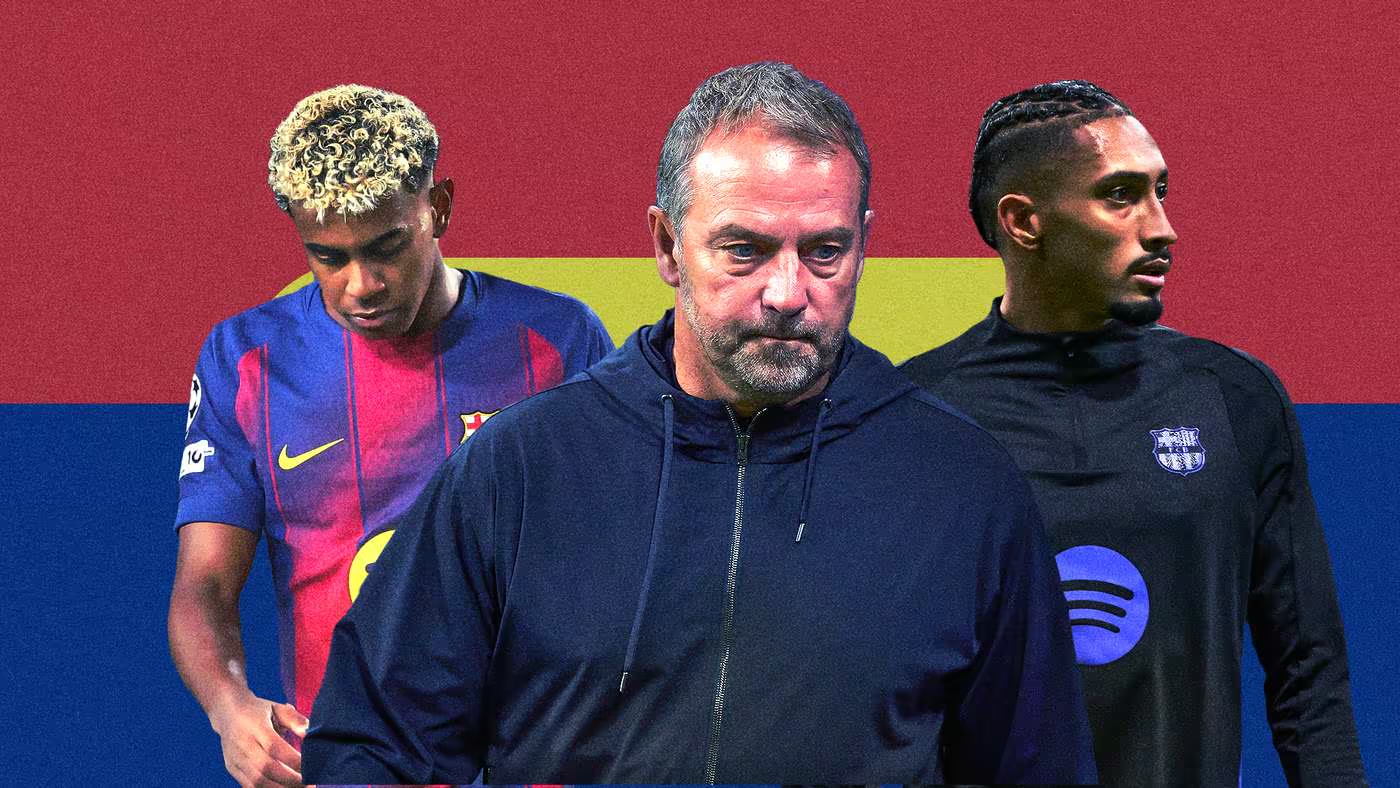
Discipline on the Bench: Flick, Alonso, and the New Order
“He will sit on the bench in the next match, I have no problem with that,” Flick said with a wry smile after a clash with Eintracht Frankfurt. The line, seemingly casual, encapsulated much of his philosophy: the coach speaks first, and seconds follow—no player is above the staff’s authority.
Although Flick later clarified the yellow-card reason, the underlying tone remained clear: the manager controls minutes, and the squad adapts or absorbs the consequence. This moment felt like a microcosm of a broader power shift unfolding across the two Spanish giants.
Madrid’s Locker-Room Power and the Economic Machine
Across the country, the Real Madrid camp has been grappling with a different kind of tension. When Xabi Alonso replaced Vinícius Júnior in the Clasico, the decision, ordinary in football, exploded into a full-blown controversy among Madrid’s stars. Even with Vinícius’ apology and the club’s insistence that the matter is closed, the optics tell a harsher tale: Alonso has become unusually cautious in managing the Brazilian’s minutes.
Not only Vinícius enjoys influence; Kylian Mbappé has become an even more protected figure inside the club, a status many would find understandable given his electric form at the start of the season and his goalscoring leadership in La Liga and the Champions League—if only the scenario were real for Madrid. Meanwhile, Luka Modest or Arda Güler are caught in the crossfire of evolving hierarchies.
Valverde’s case underscores a different flavor of power: reports suggest he refuses to play right-back, a sign that players’ leverage in the dressing room is climbing higher than ever. Real Madrid’s challenges appear to stretch beyond tactics and into the commercial and economic dimensions that frame modern football.
Leaning on reports from The Athletic and AS, the narrative paints Real Madrid as a club where players are increasingly treated as investment projects, with extensive influence over sponsorships, branding, and the broader business of football. The result is a kind of “technical-economic” layer that protects certain players and makes them hard to discipline, regardless of what happens on the pitch.
Barcelona’s Order vs Madrid’s Chaos: The Different Roads Ahead
In contrast, Barcelona presents a more disciplined tableau. Flick remains the ultimate decision-maker, while Lewandowski, Rafinha, and Ferran Torres navigate the lineup with less drama than their Madrid counterparts. Lamine Yamal’s Clasico challenge was contained by the club’s leadership, and he emerged ready to contribute again, showing that discipline can coexist with youthful brilliance.
The saga around Yamal—described in some circles as “the theft of the win”—has been absorbed, and the club has kept him close, reinforcing the idea that talent must be matched with accountability. The day-to-day reality at Barça is a team that acts as one, with a visible hierarchy that keeps egos in check and performance at the forefront.
What we see is a club where the coach’s authority is reinforced by a collective culture. Barcelona’s environment contrasts sharply with Madrid’s growing perception that the locker room holds the real power, and the bench becomes a stage for a broader power play rather than a simple tactical choice.
Madrid’s fragility—an alarm bell for Florentino Pérez and the board—signals that if Real Madrid does not rethink its structure, the club risks a longer fall from its European dominance. A renewed sports director role and a coach who can translate a clear identity from boardroom to training ground are among the steps many believe are necessary to reset the club’s trajectory. The alarm bells aren’t just about a single match or a single player; they point to a systemic question about how power, money, and performance intersect in the modern game.
And so we arrive at a simple truth:Barcelona’s current model champions the chain of command, while Madrid’s environment suggests a tug-of-war between stars and strategy. The ultimate question is whether Madrid will embrace a structural change or risk another trophy-less season while the bench and the board debate who owns the club’s soul. The return to football as a discipline-first enterprise—rather than a gallery for star power—could be the catalyst Madrid needs to reclaim its identity.
Until then, the drama will continue to unfold on the training grounds, in the press room, and in the whispers of locker rooms where the real decisions are made. The solution may be delayed, but the compass is clear: Real Madrid must re-center the sport over the spectacle, and Barcelona must keep turning that dial just a notch more toward unity and discipline.
Two punchlines to wrap this up: First, if your bench has more power than your coach, congratulations—your team has achieved the most expensive seat in football. Second, in football as in life, the best defense is a good lineup—so maybe the bench isn’t punishment, it’s a strategic spa day for the manager’s nerves.



.jpg?quality=60&auto=webp&format=pjpg&width=1400)