
Arab Cup and Nations League: From Emergency Mindset to European Laboratory of Talent
25 November 2025
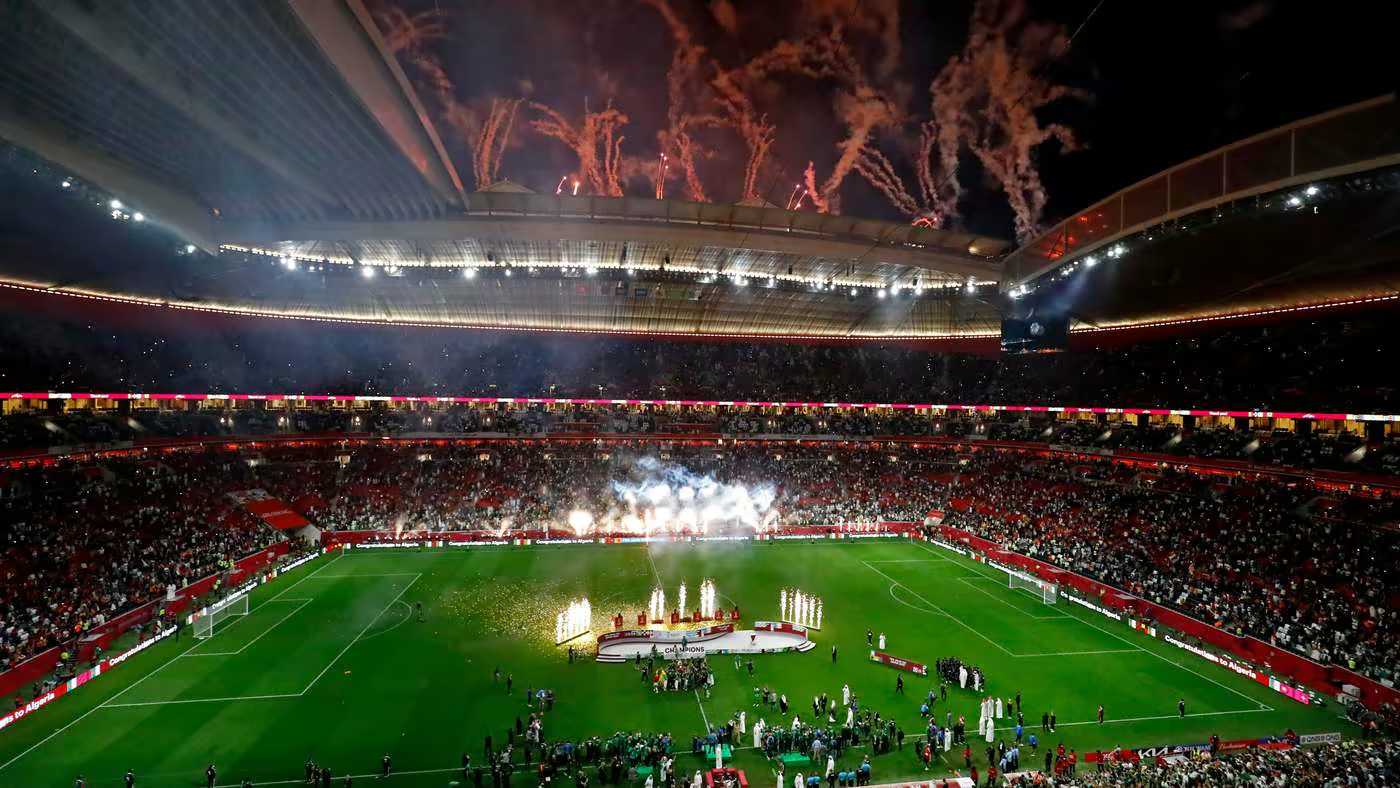
A Youthful Arab Cup Under International Scrutiny
A scene from a Saudi national team match in the 2021 Arab Cup featured a lineup dominated by young players and reserves, even though FIFA formally recognises the tournament and places it under its umbrella. This setup mirrors how some Arab federations regard the competition.
The big Arab nations did not field their first teams, making the tournament look more like a reserve league than a regional title chase.
For example, Algeria sent a locally based squad in 2021 with a handful of players from other Arab leagues; Morocco followed suit with a fringe squad backed by players from Arab leagues. Saudi Arabia, meanwhile, fielded almost an entirely under-23 side.
Statistics reinforce this perception: only about 15 players in the 23-man squads played outside Arab leagues across 16 participating nations. This means the majority of Arab stars who ply their trade in Europe—the backbone of the top national teams—were absent from the Arab Cup. Notable omissions included Mohamed Salah, Riyad Mahrez, and Achraf Hakimi.
This approach generated a “trial and emergency” mindset. Teams entered the tournament with aims other than merely winning the title, and while there were honest intentions to develop a second tier, there was a clear lack of cohesion and long-term planning. The gap between how core teams perform in major events and how shadow teams perform in the Arab Cup was evident. Saudi Arabia, for instance, led their World Cup 2022 qualifying group at one point, yet their reserve squad exited the Arab Cup in the group stage after a draw and two losses with a tepid showing.
If federations want to keep and improve this tournament, they may need to shift mindsets and recognise that it can be a structured platform to nurture a second generation, much like Europe does in the Nations League.
Diverging Philosophies: Emergency Mindset vs Long-Term Build
The European Nations League tells a different story—a success born from initial doubt, evolving into a valuable, well-structured competition.
Created by UEFA in 2018 as an alternative to endless friendlies, it was initially met with skepticism. Critics asked whether Europe needed another competition or if these games would remain mere friendly vibes under competitive armor.
Yet the first edition exceeded expectations, and UEFA president Aleksander Čeferin admitted the tournament achieved more than anticipated, replacing pessimism with broad, continent-wide optimism.
It introduced promotion and relegation, grouping teams of similar level so that matches were meaningful. It became a genuine laboratory for building new generations by pairing immediate competition with long-term development goals.
In England, for example, a young cohort benefited from the Nations League during 2019–2021 under Gareth Southgate, accelerating their readiness for major tournaments. By Euro 2020 (played in 2021), talents like Phil Foden, Mason Mount, and Bukayo Saka had matured into key players.
Spain used the Nations League to reforge itself with a youthful core under Luis Enrique. Pedri and Gavi shone, alongside Ferran Torres, as Spain challenged Italy and France in the final, ultimately clinching the title in 2023 and validating the strategy of a measured rebuild.
France, holder of the 2018 World Cup, leveraged the Nations League to refresh the squad after a Euro 2020 setback. Didier Deschamps brought back Karim Benzema and experimented with a 3-4-3 formation to inject more attacking thrust. In the finals, France’s mix of veteran stars and fresh faces—like Jules Koundé, Theo Hernandez, and Aurélien Tchouaméni—helped them win the competition.
The lesson is stark: European teams have treated Nations League as a strategic project, not a mere side-show. It became a platform to test new tactics and players within a meaningful competitive framework, while still pursuing trophies.
Over time, the competition shed its “experimental” label and gained intrinsic value. France added the Nations League to its World Cup and Euro trophies, and mid-tier nations also used the format to advance to European tournament conclusions or secure qualification routes via the league structure.
Comparing the two experiences makes the difference clear. The European model demonstrates how to marry development with competitiveness; the Arab Cup still looks like a temporary, separate event with limited integration into broader strategic plans. European teams integrated rising stars into serious campaigns; Arab teams, at least so far, offered opportunities to the reserves without a coherent pipeline to major events.
The underlying difference is long-term thinking. The Nations League, as it evolved, convinced many that experimentation and competition can coexist and reinforce each other. The Arab Cup, despite its potential, lacks a durable, forward-looking plan that translates into sustained success across future cycles. Qatar’s successful 2021 hosting demonstrated the appetite for a regional showcase akin to Euro or Copa America, and FIFA recognition could anchor it in a consistent cycle—perhaps every four years. But maintaining the current mindset may limit its development, especially given scheduling conflicts with European leagues that complicate player participation.
In short, the Arab Cup needs a strategic shift toward long-term planning and a genuine pathway for young talents to reach the continent’s top stages. The Nations League, meanwhile, stands as a proven blueprint for turning doubt into a productive, competitive laboratory for national teams.
PUNCHLINE 1: If football were a diet, the Nations League would be the gym—lots of reps, better legs, and the occasional win-lift combo that makes you feel like you actually trained. Punchline 2: Meanwhile, the Arab Cup is like a warm-up playlist—good vibes, plenty of energy, but you still hope the main concert is coming soon and with a proper encore.