
Adil Bashir: The Iraqi Football Legend Who Built a Legacy with a Military Edge
29 November 2025
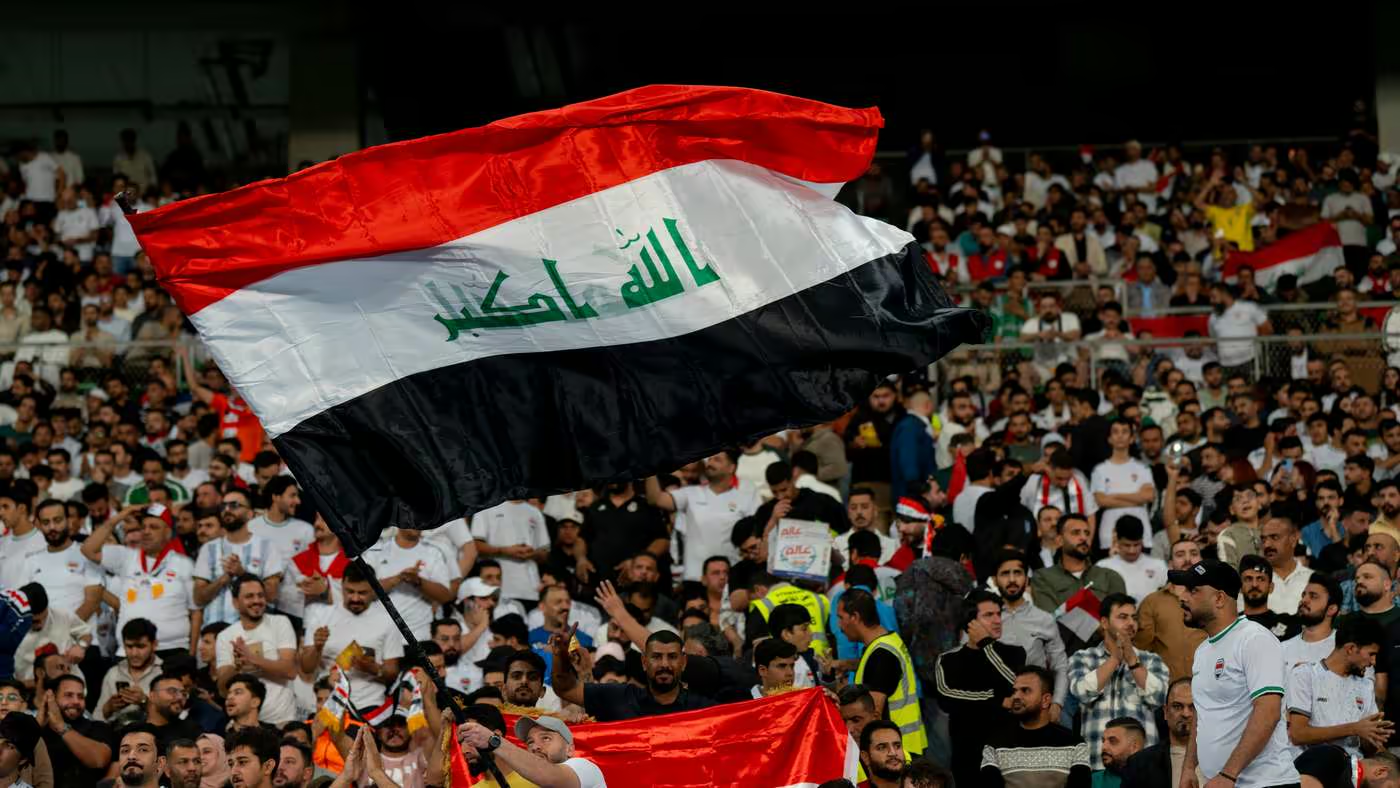
A Warrior Coach: Adil Bashir and the Military Roots of Iraqi Football
Iraq’s national team leads the Arab Cup with four titles, and two of those triumphs came under the guidance of Adil Bashir, the national coach who remains the only figure to win the tournament twice in its history.
Bashir, who worked across every facet of football during the 1960s and early 1970s, was one of the era’s most prominent Iraqi coaches, a figure whose name is tied to many of the period’s achievements.
Born in Mosul in 1926, Bashir had a brief playing career and represented the Military College team. He was invited to play for the Royal Guard team that faced Pakistan’s military side in a friendly in Baghdad in 1950.
He also played for the Iraqi military team at the Asian Army Games in Tehran in 1955, and retired from playing to focus on work after graduating from the Baghdad Military College in 1951.
Yet he could not forget football, and he became secretary of the Iraqi Football Federation in 1960, later serving two terms as federation president (1964–1966 and 1971–1972).
He also served as the assistant secretary general of the Iraqi Olympic Committee and worked in football refereeing. But his greatest achievement for Iraqi football was guiding the national team to Arab Cup glory in both the Kuwait edition of 1964 and the Iraq edition of 1966.
He also led the Iraqi military team to win the World Military Championship in Baghdad in 1972, the Arab Army Championship in 1965, and the West Asia Championship in 1971, a competition that served as a qualifier for the Asia Cup.
Three Stints and a Military-Style Blueprint
Adil Bashir is regarded as the second Iraqi coach with a military background to helm the national side, and he did so across three coaching spells, delivering notable successes in each chapter.
The first spell in 1964 saw Iraq triumph in the Arab Cup in Kuwait. The team beat Kuwait and Lebanon by 1–0, defeated Jordan 3–1, and drew with Libya 1–1. The tournament used a round-robin format, and Iraq won the title by a single point ahead of Libya, marking the country’s first major football crown since joining FIFA 14 years earlier.
The second spell in 1966 saw Bashir lead Iraq to a runner-up finish at the Triangular Cup in Tripoli, Libya.
He then steered the side to defend the Arab title when Iraq hosted the tournament in April 1966, the first major event hosted by the country with 10 participating teams. Iraq defeated Kuwait 3–1, Jordan 2–1, and Bahrain 10–1, the latter the biggest Arab Cup victory in the competition’s history. Iraq then drew with Lebanon 0–0, topped the group on goal difference, and in the semifinals beat Libya 3–1 and Syria 2–1 in the final in Baghdad, securing the Arab Cup again. The Arab Cup competition paused after that edition and was revived in 1985; the last Iraqi appearance under Bashir’s second spell came in a friendly against Benfica that finished 2–1 in favor of the Portuguese club.
The second term ended with a record of seven wins, one draw, and three losses, a tally that convinced the Iraqi federation to bring him back for a third spell in 1971.
During the 1972 Munich Olympic qualifying campaign, Bashir led the team at a crucial juncture after replacing the Soviet coach Yuri Ilchiev. Iraq won the first leg against North Korea in Baghdad 1–0 but lost 0–3 in the return leg in Pyongyang, exiting the qualifiers. He remained in charge through the broader West Asia and Asia Cup qualification process, guiding Iraq to the Asia Cup finals for the first time in 1972 during a West Asia round staged in Kuwait. Iraq topped the group with wins over Libya 3–0 and Kuwait 3–1, drawing with Egypt 0–0, then defeating Algeria 3–1 in the semifinals before losing the final 1–3 to Egypt.
The Palestine Cup in Baghdad in 1972 was Bashir’s final appearance as Iraq coach, a run that yielded 11 wins, two losses, and two draws in 15 games during that period. Overall, Bashir’s three coaching stints produced a total of 30 matches with 21 wins, four draws, and five losses.
Adil Bashir remains the longest-serving Iraqi coach of the 1960s and early 1970s, a record later surpassed by the legendary figure in Iraqi football, the longtime coach who followed in his wake.
Humor break: If tactics were weapons, Bashir’s playbook would be a fortified bunker. And if patience were a card, he’d be sitting on a full house—because in football, even a delay can be a knockout punch for the opponent. Punchline two: I asked Bashir for a defensive tip and he handed me a map of West Asia—apparently, defense is all about knowing the lay of the land. And finally, if you want a true masterclass in resilience, just watch how his Roma, I mean Iraq, line up and you’ll understand what a human wall looks like on grass.