
Kroos on Barca: Europe’s Most Magnetic Style, with a Cautious Flag
7 October 2025
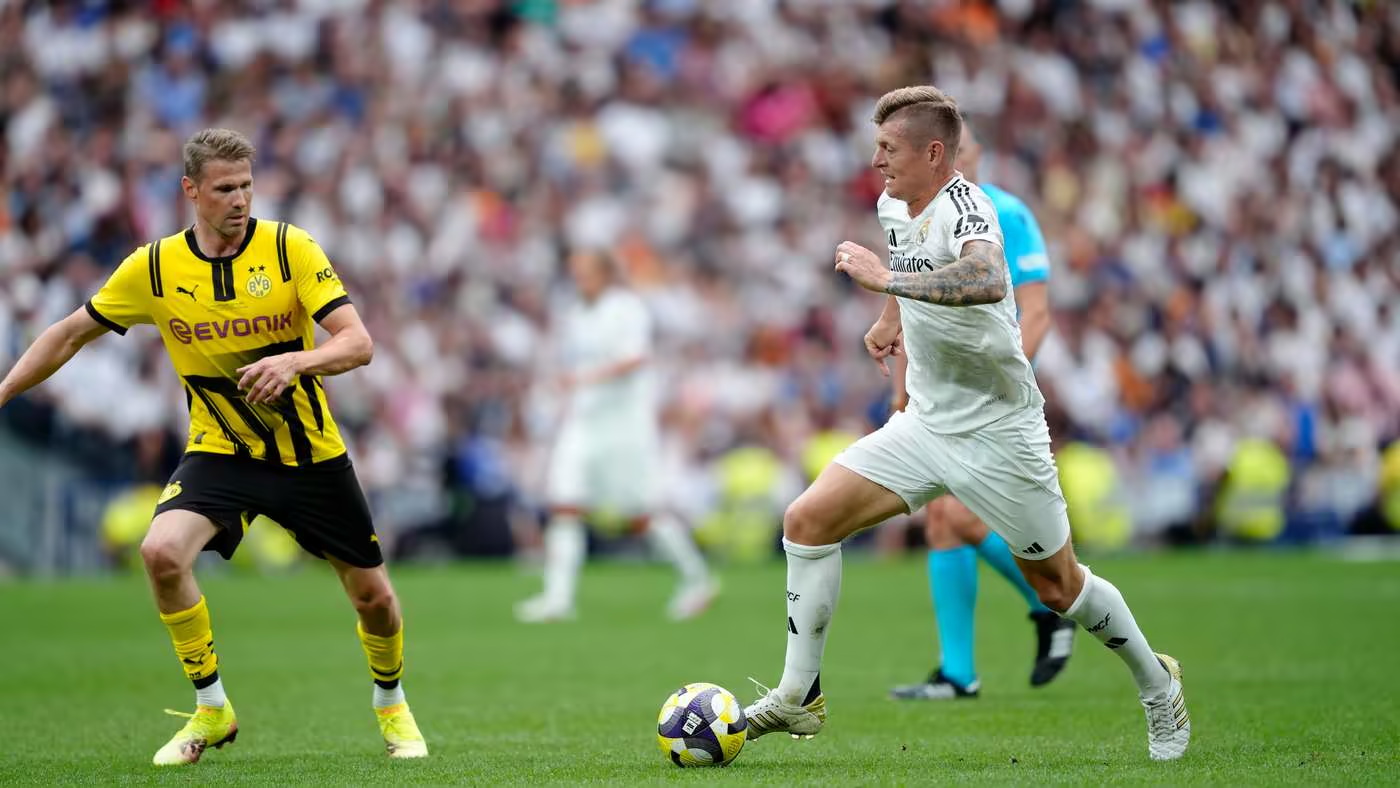
Barcelona’s Allure with a Cautionary Note
Toni Kroos, the legendary Real Madrid midfielder, has praised Barcelona’s playing style as among the most attractive in Europe, while also warning that Barca’s open attacking approach carries significant defensive risks. He shared these thoughts on a podcast with his brother Felix, according to Mundo Deportivo, reflecting on Barca’s performances in the latest season.
He pointed to Barca’s recent setbacks—losing 2-1 to Paris Saint-Germain in the Champions League and 4-1 to Sevilla in La Liga—as examples that underline why aesthetics alone do not guarantee safety. Kroos offered a frank technical analysis of why results have dipped and what might come next for the Catalan club.
“Barcelona has one of the most attractive playing styles in Europe, perhaps the most attractive ever,” Kroos said. “But they bear big risks. On a bad day for Pedri, Lamine Yamal, or Rafinha, any United Nations of a defense could hurt them and knock them out of the Champions League.” He stressed that Barca’s high defensive line leaves them exposed to well-organized opponents capable of exploiting space.
He recalled that the risk has materialized before, noting last season’s semi-final defeat to Inter Milan in the Champions League. “This season, in the knockout rounds—whether the round of 16, quarterfinals, semis, or the final—they will face opponents who’ll pose the same problems.” In domestic play, he conceded the issue is less likely to manifest given Barca’s dominance in La Liga, but the European stage remains a different test.
Fatigue as a Decisive Factor
Kroos also highlighted the physical aspect of Barca’s challenge, pointing out that fatigue tends to intensify after the 75th minute. “From the 75th minute onward, you can see everyone feeling the strain, and they don’t always adjust their approach to close spaces,” he explained. When you’re tired and you don’t adapt, vulnerability becomes obvious.
Kroos’s Career Path
Kroos began his footballing journey in the youth ranks of Hansa Rostock before moving to Bayern Munich’s academy at 16. He caught the eye with his exceptional passing, accuracy, and field vision. He made his first-team debut for Bayern in 2007-08 at just 18, becoming one of the Bavarian club’s youngest-ever players.
After a productive loan spell at Bayer Leverkusen (2009-2010), he returned to Bayern as a regular under Jupp Heynckes. During his Bayern years, he collected multiple trophies: three Bundesliga titles, two DFB-Pokals, the 2013 Champions League, the UEFA Super Cup, and the Club World Cup, earning a reputation for precise long-range passes and composure under pressure.
In the summer of 2014, Kroos joined Real Madrid for around €25 million—a move widely regarded as a landmark in the club’s modern era. With Real Madrid, he formed one of the era’s most celebrated midfield trios alongside Luka Modrić and Casemiro, helping the team dominate Europe for years.
Over ten years with Real Madrid, Kroos claimed five Champions League titles, four La Liga championships, a Spanish Super Cup, a Club World Cup, and a UEFA Super Cup. His precision passing, calm tempo control, and ability to dictate the pace of big matches contributed to Real Madrid’s sustained European success from 2016 to 2022.
International Legend
On the international stage, Kroos earned 114 caps and scored 17 goals for Germany. He emerged as a key figure in Germany’s 2014 World Cup triumph, delivering decisive performances on a global stage. He briefly stepped back from international play in 2021 after Germany’s Euro 2020 exit, before winding down his national-team career in 2024 with the German squad. Today, Kroos stands as one of the century’s finest midfield maestros, a symbol of German rigor and tactical discipline.
In summary, Kroos’s assessment blends admiration for Barca’s aesthetics with a sober warning: beauty can be risky when the backline is left exposed, especially against Europe’s most prepared teams. Humorously, he might quip that even the ball has standards—preferably a crisp pass over a wandering dribble.
Punchline 1: Barca’s plan is so sleek that even the defense wears sunglasses to cope with all that shine. Punchline 2: If defending Barça were a sniper duel, you’d need a polite referee and a compass—because the ball will find every little seam, and you’ll still owe the latte you spilled on the way to the scoreboard.