
From Red Card to Royal Knight: Beckham's England Redemption
27 January 2026
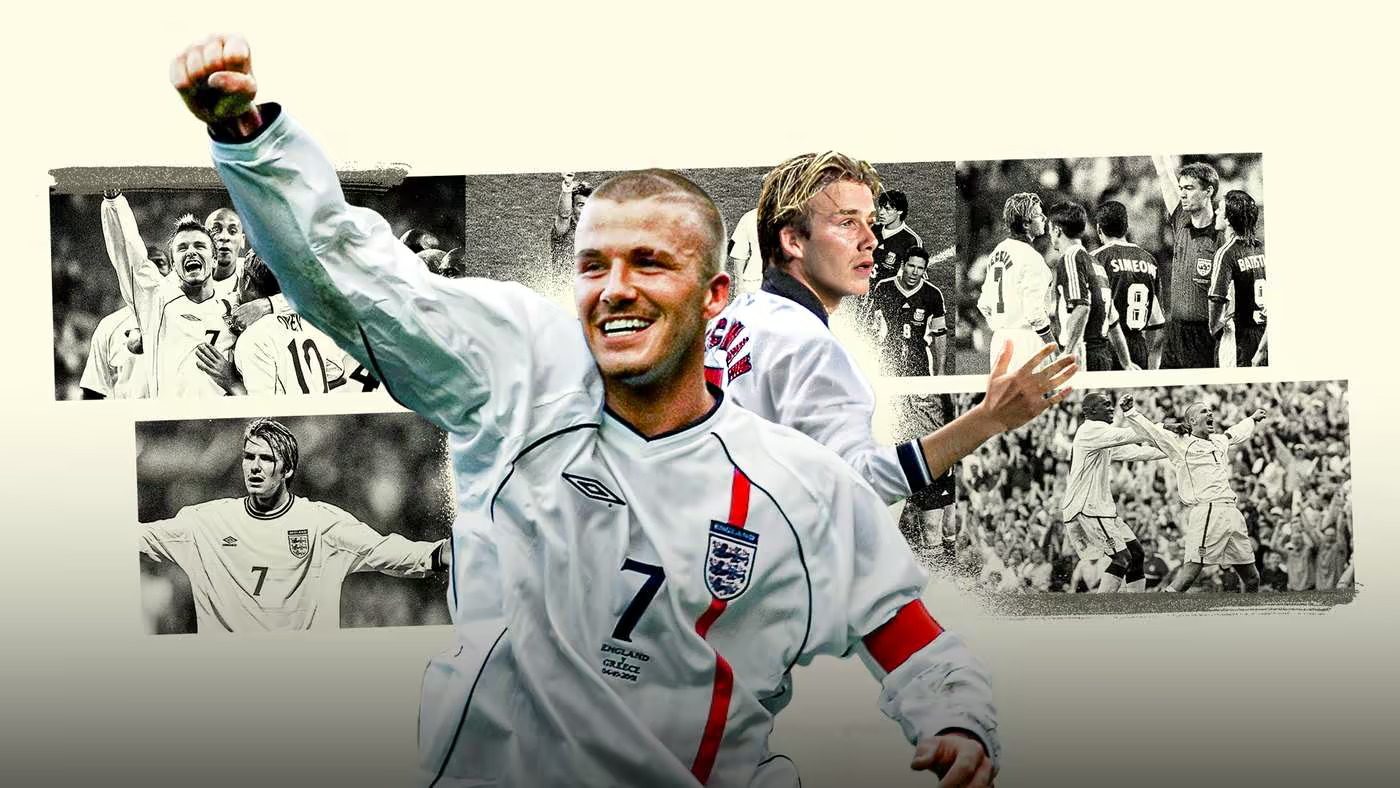
Rise of a Star
By the time the 1998 World Cup arrived, Beckham had become a regular at Manchester United for three seasons. He formed part of the famous Class of ’92 alongside Paul Scholes, Ryan Giggs, Nicky Butt, Gary Neville, and his brother Phil Neville. Under Sir Alex Ferguson, United were the dominant force in English football, and Beckham’s disciplined work ethic and growing skill helped him evolve into one of the game’s premier set-piece specialists.
He broke into the first team in the 1995-96 season, truly made his mark in 1996-97 by earning the Professional Footballers’ Association Young Player of the Year, and soon after made his England debut just after Euro 1996. The blend of relentless practice and natural flair would make him a global star, admired and criticized in equal measure.
Nightmare Moment
Yet the road took a brutal detour in 1998. At the World Cup in France, Beckham found himself at the center of a storm after a red card against Argentina in a heated Round of 16 clash. It was a moment of reckless retaliation that the nation would remember—and condemn—long after the match had ended.
Beckham later acknowledged that the incident marked one of the darkest hours of his career, publicly apologizing to teammates and supporters. He argued that football had always come first for him and that he needed a chance to prove what he could do when given the opportunity again.
Battle at Saint-Etienne
The Saint-Etienne encounter with Argentina remains one of football’s most discussed chapters. The match swung back and forth, with penalties, goals, and mounting tension. Beckham’s moment came amid a chaotic sequence that ended with Diego Simeone’s challenge and a red card for Simeone as Beckham reacted in frustration, later described as a costly, mistaken overreaction.
The referee, Kim Milton Nielsen, showed Beckham a red card, a decision that changed the complexion of England’s World Cup campaign. The incident framed a narrative of a young star forced to endure public scrutiny and to prove his worth in the face of adversity.
Public Enemy No. 1
In the days that followed, Beckham was vilified in the press. The Mirror ran a provocative line, and other outlets echoed harsh sentiments about the season’s setback. Fans burned effigies and threats were reported, with polls suggesting a significant portion of Manchester United supporters questioned whether he should restore his place in the England squad.
Beckham’s response was unequivocal: he apologized, reiterated his focus on football, and stressed that he would have gladly given a penalty attempt if given the chance. He explained that the moment had not defined him, and his resolve to prove his abilities remained intact.
Fighting Depression
In a 2023 Netflix documentary focusing on Beckham and Victoria, the star opened up about the darker days that followed. He described days of pain, sleepless nights, and relentless abuse, noting that the public pressure took a heavy toll on his wellbeing. The support from teammates and the club helped pull him through, and the beaming light of football gradually returned as he rebuilt confidence on the pitch.
Beckham recalled how those difficult times reinforced the importance of resilience, mentorship, and the sense of safety that football could offer—a feeling that allowed him to pursue redemption with renewed focus.
Seeking Redemption
Beckham’s quest for redemption intensified as he captained England for the first time in November 2000 under Sven-Goran Eriksson. He emerged as a leader of a so-called Golden Generation, helping restore belief in the national team after years of pain. England’s 5-1 victory away to Germany boosted confidence, but there was still work to do to secure a place at the 2002 World Cup in Japan and Korea.
With time running out in the qualifying clash against Greece at Old Trafford, Beckham delivered a curling free-kick that clinched qualification. That goal transformed his standing and became one of the most celebrated moments in England’s modern football history.
Beckham added another goal for England in the 2002 World Cup group stage against Argentina, and while England’s campaign ended in heartbreak at the hands of Brazil in the quarterfinals, the arc of his career had clearly shifted. He retired with 146 goals in 724 appearances, 17 trophies, and a club résumé spanning Manchester United, Preston North End, Real Madrid, LA Galaxy, AC Milan, and Paris Saint-Germain.
In 2025, Beckham finally received the knighthood many felt he had earned long ago, with King Charles III bestowing the title of Sir David Beckham. A career that once sparked controversy had become a global legend—a reminder that even a red card can be a stepping stone to immortality.
Beckham’s legacy endures: a globally recognized leader, ambassador, and benchmark for English football and beyond. He remains a symbol of how a life in sport can transcend the pitch and become part of a nation’s story.
Punchlines: When Beckham steps to a free kick, gravity files for a rematch. And if life ever hands you a red card, just tell the referee you’re Beckham—mistakes forgiven, legends born. And yes, the world still streams his legend, because some rocks are simply timeless ballast for football’s future.