
Spain's Next Golden Run: Can Yamal Echo Iniesta and Rewrite 2026 World Cup History?
20 January 2026
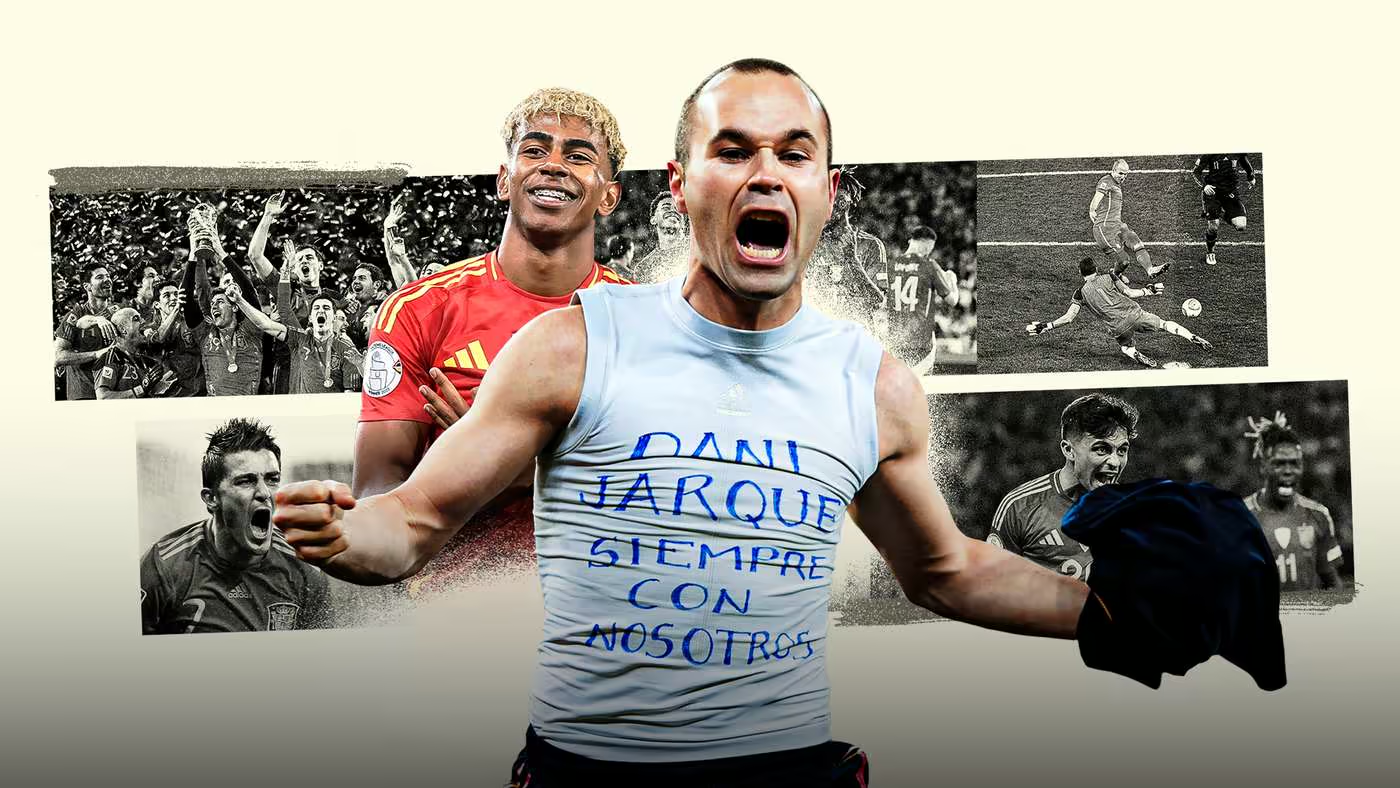
Weight of Iniesta's Legacy
In the collective memory of football, some moments never fade. July 11, 2010 in Johannesburg stands as more than a date; it is the night when a nation finally tasted dreamlike success. No longer the underdog, La Roja lifted the World Cup trophy after beating the Netherlands, a triumph that celebrated talent and conviction alike. The goal that defined the night—Iniesta’s late strike—made him more than a great player: he became a symbol for a generation.
Iker Casillas’s saves, Carles Puyol’s leadership, Xavi’s intelligence, and David Villa’s goals all formed parts of a flawless machine. Yet it was Iniesta who etched the moment into history, the face of a blueprint that Spain would carry forward. The 2010 team did not rely on sheer star power; it worked as a cohesive system that maximized every asset through intelligent possession and patient timing.
Spain 2010 was the culmination of a process begun with Euro 2008, a philosophy built on ball dominance and patient pressure—an approach Del Bosque kept alive with a blend of continuity and subtle evolution. The result was a trio of major titles in a row, a testament to a national style that could win gracefully and forcefully at the same time.
The essence of the era wasn’t just the trophies; it was the identity that remained etched in football’s memory. The generation that lifted Europe and the world proved that beauty can be efficient, that a team can be both art and weapon. That legacy continues to echo as Spain enters a new cycle where youth and experience must again align to conquer global stages.
Now, nearly 16 years later, the champions’ baton passes to a different group. Spain arrives at the 2026 World Cup with a fresh line of talent, led by a teenager who has already turned heads in Barcelona and beyond. The link between eras remains clear: a belief that collective genius, more than raw firepower, wins the big prizes. If the new cohort can respect the blueprint while writing its own language, the path from 2010 to 2026 looks less like a replay and more like an evolution.
Yamal: The New Spark
At 18, Lamine Yamal has already carved a niche as one of Europe’s most talked-about talents. He blends speed, dribbling, creativity, and a maturity that belies his years. Far from being daunted by expectations, he plays as if he’s born to carry a nation’s hopes, with a calm that many veterans would envy. The contrast with 2010 is stark—this is a new breed that attacks with vertical thrust and improvisation, rather than a measured, patient buildup alone.
Where Iniesta’s genius stood as a calm compass, Yamal offers a catalytic spark. He can receive the ball near the touchline, beat defenders, and conjure chances from seemingly nothing. He can fashion a goal with a feint or an unexpected pass that unsettles even the most organized defenses. In him, Spain sees not a mere successor to a symbolic role, but a player who could redefine a generation’s approach to the game.
The surrounding cast is stocked with talent too. Pedri and Gavi carry the unifying thread of Spain’s midfield, while Rodri provides balance. In defense, young anchors stand alongside the experienced parts of the squad, and up front, players like Nico Williams bring pace and unpredictability. It isn’t about a single savior; it’s a generation ready to cooperate, with Yamal as the spark that could lift the team in moments that demand magic.
This is a Spain that won’t simply replay 2010; it will reinterpret it. The old model’s patience remains a backbone, but the emphasis shifts toward breaking lines, one-on-one battles, and constant surprise. The potential is clear: a team that can combine a robust identity with modern tempo and audacity—a recipe that could yield a new crown if the pieces click at the right times.
The team’s composition signals more than a mere renewal. It signals a project: Pedri and Gavi as heirs to Chaví and Iniesta’s playmaking, with Rodri offering the shield, while a new wave of attackers gives new angles to Spain’s attack. The objective is still to win, but the path now blends patient buildup with rapid transitions and deadly counter-punches, a hybrid that could trouble even the most formidable opponents.
Spain enters the World Cup 2026 not as an underdog, but as a serious contender, anchored by a belief in the national identity and the power of collective talent. The hope is that Yamal’s leadership will emerge in tandem with the maturity of a cohesive unit, proving that the era’s magic is not a relic but a living blueprint that evolves with each generation.
In the broader arc, Yamal represents a living bridge between two epochs. Iniesta’s tranquil genius and the 2010 identity can coexist with a modern, vertical, fast-moving Spain that invites a new sense of danger and excitement. If the 2026 team manages to harmonize those strands, the comparison to 2010 will feel less like a replication and more like a continuation with a sharper edge.
Future-facing and hungry, Spain’s young squad carries not only the weight of a legacy but the pressure to reinvent it. The World Cup stage will be the ultimate test of whether a generation can translate a cherished philosophy into contemporary success. If Yamal rises to lead with both flair and responsibility, the story will become a legend in its own right.
Continuity and Change
Comparing Spain’s 2010 side with the 2026 lineup is a balancing act between nostalgia and analysis. The 2010 team was a fully mature unit, with Chavi and Iniesta orchestrating play, Villa delivering goals with surgical precision, and Casillas keeping the door closed at crucial moments. Every decision was deliberate, every movement meaningful within a system that functioned like a finely tuned machine. That maturity allowed D el Bosque to control games and make late game calls with conviction, even when opponents tried to disrupt Spain’s possession game.
Spain 2026, by contrast, is a work in progress. Younger, more dynamic, less tested, but bolder. Pedri and Gavi provide echoes of that old control, while introducing speed and verticality. Rodri offers balance, and attackers like Yamal and Williams bring unpredictability. The primary difference lies in how they attack: a willingness to break lines, take on defenders, and maintain a high tempo that keeps opponents off balance. It’s the same philosophy—team over individual brilliance—applied through a modern lens of risk and tempo.
In this framework, Yamal is not just another player; he’s a symbol of the project’s future. He represents the youthful face of a plan that could guide Spain through the next decade, while still honoring the patient, intelligent style that brought European glory in 2008 and the World Cup in 2010. If he can translate his promise into decisive performances at the 2026 World Cup, Iniesta’s legacy may find a new chapter in his hands, a continuation rather than a repetition of the past.
As the World Cup 2026 approaches, the key questions remain: Can Spain balance youth with experience? Will Yamal shoulder leadership duties and propel the team to glory? The answers lie not only in talent but in the cohesion and resolve of a squad that has the chance to turn a powerful idea into a lasting reality. And if they pull it off, the tale will read like a modern classic: two eras linked by a single belief—that genius thrives when a team plays as one, and that the future can be brighter when the past refuses to be forgotten.
Yamal isn’t merely a player; he’s a beacon of hope, a spark that could ignite a new era of Spain’s footballing story.
Punchline 1: If Yamal carries Spain to the title, the only thing heavier than the trophy will be the headline writers’ stock options—get ready for a flood of glorious clichés.
Punchline 2: If football were a novel, Yamal would be the cliffhanger—every page ends with what he’ll do next, and yes, the chapter titles are already shouting, “Unbelievable.”